Monday, February 6, 2012

Magic the Gathering - My Made-up Cards

Hello everyone, this week I was given the task to create three new cards for the popular card game, Magic: The Gathering. Within that task, I was to balance the cards so that they can be playable in the actual game; costs = benefits. The rules for both costs and benefits are as follows:

Costs:
 Baseline = +1
 Each colourless mana = +1
 Each coloured mana = +2
 Total mana cost of 5 or more = +1 (+2 for Green)
Benefits:
 Each 1 Power or 1 Toughness = +1
 Being Red or Blue creature = +1


First up is the Isolated Boy.

His costs include:
1. The card baseline. (1)
2. Three colourless mana. (3*1=3)
3. One coloured mana. (1*2=2)
4. The cost so far is >= 5, but the card is not green, so there's only an added cost of one. (1)
5. Together, that equals 7.

His benefits include:
1. Power of 3.
2. Toughness of 4.
3. Not a Red or Blue creature. (0)
4. Together, that equals 7.

Isolated Boy's cost (7) equals its benefits (7), and is therefore balanced.


Next up is the Toddler's Drawing.

His costs include:
1. The card baseline. (1)
2. One colourless mana. (1*1=1)
3. One coloured mana. (1*2=2)
4. The cost so far is not >= 5, so there's no added cost. (0)
5. Together, that equals 4.

His benefits include:
1. Power of 2.
2. Toughness of 2.
3. Not a Red or Blue creature. (0)
4. Together, that equals 4.

Toddler's Drawing's cost (4) equals its benefits (4), and is therefore balanced.


Finally, we have Linkolian. No he is not Link from Nintendo's "The Legend of Zelda", he just looks strikingly similar to him. Sheer coincidence, honest! =P

His costs include:
1. The card baseline. (1)
2. Fifteen colourless mana. (15*1=15)
3. One coloured mana. (1*2=2)
4. The cost so far is >= 5, and the card is green, so there's an added cost of two. (2)
5. Together, that equals 20.

His benefits include:
1. Power of 10.
2. Toughness of 10.
3. It is not a Red or Blue creature. (0)
4. Together, that equals 20.

Linkolian's cost (20) equals its benefits (20), and is therefore balanced.

So that's that. Whadda ya guys think? Fancy? =]

Thursday, February 2, 2012

Pokemon Resources Short Critique


                Pokémon is a well-balanced game that uses many variables in a very intricately laid out fashion.  They work together to give a realistic feel for the Pokémon world; allowing each Pokémon to be unique, even if they’re of the same species. Looking back to a previous iteration of the series, Pokémon Fire Red version, there was a frustrating spike near the end of the game. After attaining the final badge which allows the player to challenge the Elite Four, their Pokémon are significantly stronger than the final gym leader. This usually causes the player to farm their Pokémon’s experience points in order to level them up. Since the amount of experience points required to level up increases relatively to a cubic exponential degree, it will (for example) take a while for the player to level up his Level 50 Charizard to Level 60. That’s the most important part I would change. Thankfully, I feel that Game Freak addressed that issue in future games, like in the recent Black and White versions.

                There is one other aspect I would like to change, albeit a small issue, and it hasn’t been addressed even to this day: Poké Ball prices. I feel that the decreasing triangle relationship works for the regular Poké Balls, however all of the special Poké Balls are priced the same at 1000 currency. For the regular Poké Balls, they cost 200, 600, and 1200 for Poké, Great, and Ultra respectively. (There is only one Master Ball per game which the player receives as a gift near the end of the game.) The special Poké Balls benefit the player only under certain circumstances. So why bother purchasing a special ball, when one can buy an Ultra Ball for just 200 extra? Ultra balls have a x2 catch rate for all scenarios, while special Poké balls have a x1 or x3 catch rate depending on if the player used it in the particular scenario that it’s supposed to be used for. As a long-time Pokémon gamer, I feel that such specific scenarios occur very infrequently. There are also many different special Poké Balls, and it would be costly to purchase one of each ball for scenarios that the player may not even encounter. To boot, other than the Master Ball, there’s never a guaranteed catch; so if the player uses her only ‘Fast Ball’ and doesn’t catch the Pokémon, the player will have to resort to her larger supply of trusty Ultra Balls. I believe prices of such special Poké Balls should be cheaper, maybe around the price of a Great Ball – then would I invest in them. I also believe that among the many different special Poké Balls, the prices should vary depending on the possible frequency of the special Poké Ball’s use. Other than that, I think Pokémon is awesome!


Monday, January 23, 2012

Rules vs. Mechanics

Hmm, I read something interesting: http://www.raphkoster.com/2011/12/13/rules-versus-mechanics/


One day,  Ian Schreiber  tweeted, "Game designers: in your everyday use of the terms, is there a difference between “rules” and “mechanics”? If so, what?" Raph Koster decided to answer that, but unfortunately his answer was too large enough for a tweet. He basically explained that every game is composed of smaller games, and each of those smaller games compliment each other in a fashion that supports the overall game. Each of those smaller games are basically mechanics. For example, one mechanic would be the jumping mechanic; it first considers all your previous progress (which consist of many small games), the act of jumping (which utilizes the rules of physics, especially the force against gravity), and the act of landing on an enemy to kill it (where the rule known as "player colliding with enemy and player's last position was above enemy" comes to fruition). These acts are dynamics carried out by the player through her choices, all thanks to the existence of the mechanics, and the rules that give the mechanics their existence. It's like a building; the rules allow mechanics to exist, and mechanics allow dynamics to exist.

At least that's how I understood it. To be honest, the article was quite confusing, but it gives you another designer's perspective on game design semantics. I feel knowing the difference between rules and mechanics is important, as it will help the designer break down and carefully construct her experience knowing the exact nature of her components. In this case scenario, the designer will choose rules that are not too loose and not too tight. With that, the rules will naturally generate mechanics that the player can use to partake in the game - mechanics are the part that are consciously on the player's mind, not the rules; the player knows that she can jump on an enemy to kill it, but does not think about "the rules of physics allowing force to drift the player upward", and, "collision with enemy provided that the player is above the enemy on the y-axis on the previous frame". Finally, how the player uses the mechanics become the the very essence of dynamics.

Wednesday, January 11, 2012

Alhambra board game critique

Good day, ladies and gentlemen.

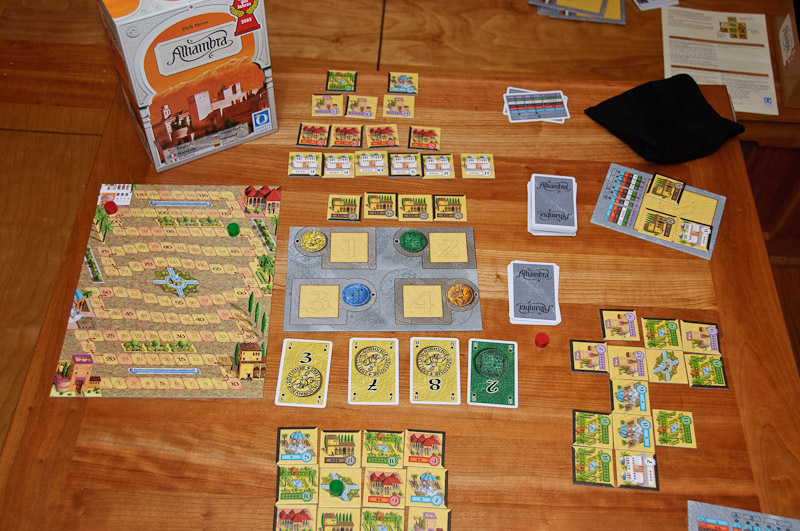
A few days ago, I played a board game called Alhambra (created by Dirk Henn) with four other people during Game Design II class. We took about fifty minutes to play it, as we were running out of time in the end. If we had the time to finish playing comfortably, we'd probably take an hour to play. The class and I were then asked to write an individual critique on the game we played. Now before I get into it, I might as well explain what the game is about, no?


Alhambra is turn-based in a clockwise order. For each turn the player has, she may choose to do one of the following; pick up money, use money on hand to buy buildings, or rearrange structures on hand. The money comes in four colours, and four are placed on the play table every turn. If the player picks up money less than a value of six, she may pick up another money card also worth less than six. The money gained can then be used to purchase buildings of the same colour. For any transaction, the player does not receive change. Each building card may have a black border around its edges; sometimes on one edge, sometimes on more than one edge, sometimes on all edges, and sometimes on no edges. The black boarders represent walls, which the player must carefully place together with other buildings to ultimately create a fortress. Inner walls are allowed, provided that the inner wall of one card is paired up with the inner wall of the adjacent building card. Regardless, inner walls provide no benefit to the player besides some leeway from having to match up walls perfectly on the outside. Sometimes buildings cannot fit in the current state of a fortress, so the player can put up to four buildings in her reserves area. When the player decides to take a turn to restructure her fortress, she can put any buildings she has in the reserves into the fortress (and vice-versa), and can rearrange her fortress however she sees fit. After the completion of one clockwise turn cycle, all players count how many points they currently have. Points are given by the amount of buildings each player has in their fortress; each building has a colour, and each colour has an associated value. So each player must add all values for each building they own, and then that total will serve as her current score. Once the game is complete, the player with the most points wins.


For the critique, the class and I were required to list five likable and five dislikable qualities of the game we played. I personally found it difficult to find ten distinct qualities I like/dislike, as points I fathomed seemed to overlap with other points. Nonetheless, I listed them the best I could:

Likable qualities:
1) The game is unique, especially thanks to its fortress mechanic.
2) There's strategy involved; for example, should I take the money or building this turn, or should I anticipate a better value next turn? Should I stock up on lower value buildings, or save up for high cost buildings that others might nab before me?
3) Inner walls allow leeway to constructing a fortress.
4) No change when buying something – contributes to strategy; if there’s money of value eight and money of value nine, pick up the money value of eight to buy building of value seven, then attempt to pick up the money of value nine the next turn.
5) Score card is like a board map, where the player’s pawn is on their score; allows player to know her score simply by glancing on the score card, rather than have someone to write it down.

Dislikable qualities:
1) The game felt repetitive and boring; it felt like busy work, a chore. I believe this is due to little challenge involved, while luck seems to mostly control the game.
2) I initially mistook the score card for the play field. I mostly found it to be useless other than taking up space.
3) Fortress doesn't seem to hold much purpose other than to include many buildings for points while requiring a wall to surround it. Player requires mostly luck to gain new parts. Not that challenging, just busy work. The game is more like a puzzle with extra tedious work if anything.
4) The same thing goes for money, luck is required to pick up the right money cards when they are displayed, and then luck is again needed to pick up the right building cards when they are displayed. It’s tedious.
5) The game is difficult to understand at first, which is a little frustrating. Once the game is understood, it's so easy to play and involves little challenge that is becomes boring.

If I could design a couple of elements differently, I'd say players should be able to bargain with other players in regards to buildings in reserves; if a player has a building in her reserves that another player needs, on his turn, he can either trade or buy her property – provided she accepts. This will increase accessibility of needed parts, which would shrink reliance on luck a little more, and thus allowing more room for strategy. Another design element I’d like to add is a more robust fortress system; each player has a pawn that can move around a game board every turn using dice, in addition to the original game. Each player’s fortress is constructed on the game board. Players can break into other players' fortresses. If a player gets to the fortress core of another player, she may decide to destroy it. She can also instead steal a building of another player’s fortress; if she does, she cannot steal anything else or destroy its core while she holds the building, so she might as well rush back to her own fortress without getting caught. Yes, in my version of the game, people can carry buildings, whadda ya know?

Anyhow, this is just what I think. How about you guys? DISCUSS FOO!!!!!!! C=<

Mr. T pities the fool who doesn't discuss in the comment section of this post.

Tuesday, January 10, 2012

ACT II

GOOD DAY LADIES AND GENTLEMEN

I HAS RETURNEDED!!!

IMPROPER USE OF GRAMMAR IS AWESOME!!!

Okay... I'm back.

Now I'm taking a course called Game Design II, which is the sequel to last year's Game Design I, where I murdered my ass off to make the world's crappiest game, Desert Racer!! Huzzah!!!! I won't be seeing you in my portfolio, sir!

No... no medal for you.
Thankfully this time, I'm continuing to develop PIVOTal with my group from last semester, and what a fine game it is so far!! This is way less stressful than last year, where I had to make a game from scratch unlike everyone else who had a game to build on from the semester before. Just thinking about that nightmare of a year makes me shudder... :(

Now THIS is what I'm talking about!! =D
Anyway, I just want to let you all know that anything that has to do with my GDW progress will now be found at http://protestersuoit.wordpress.com/. On this blog, however, I shall be posting material that is related to my Game Design II course.

Anyway, this is just a quick blog post to say that I am still alive, and see you all next post!! :)

Sunday, December 11, 2011

And we cut to intermission...

Hello y'all,

I finally completed all assignments for this semester. Now all that is left is to do exams. Since last week, I worked like crazy on my group's GDW game, marketing projects, and the Game Engine Homework. Thankfully the GDW was a great success, my marketing professors enjoyed my groups' presentations, and I nabbed all 65 exp. points for Game Engine Design. Before the GDW was due, I was working on a Particle Tool as per requirement for the GDW. Unfortunately I was not able to fully complete it, as it lacked RGBA adjustments. In case you don't know, RBGA stands for Red Green Blue Alpha. The first three colours when mixed create more or less the entire visual colour spectrum, depending on the value of each colour variable. Alpha represents opacity; the higher the value, the more opaque it is - the lower the value, the more transparent it is. After the GDW, I figured out how to integrate RGBA in my particle tool, and then submitted as part of my Game Engine Design homework mark. This brought my experience points from 35 to 50, giving me 100% of the homework marks.
This is my particle tool upon opening it. Simple grey texture with no effect applied. We can change that!
In this picture, I increased its red value, and decreased its green, blue, and alpha values. I also increased each particle's lifespan, speed, and size. Finally, I changed the direction of the emitter. Hmm... looks like a candle light!!
In my particle tool, I have three versions: point emitter (like the pictures above), planar emitter (like the one shown here), and air emitter (where all particles float around in the air). My particle tool has a feature where I can save a particle's attributes and load them whenever I want, even after I close the program. A few days ago, I set up my particles to look like mist in planar mode, and then saved its attributes. At the time of writing this post, I loaded up the text file by pressing a single button, and voila, my mist effect is back!!
However I was able to gain an extra 15 points, for a mark of 130%. I had two options, do three easy questions for an easy 15 points, or do one hard question and actually learn something that may be beneficial for studying for the exam. I chose the latter. The hard question I chose to do was a Normal Map Shader, that essentially makes a 3D model look more realistic. It proved quite difficult (hence why it's a "hard" question), and asked the professor for help. Unfortunately I was unable to complete it in time, however I did learn the theory of it quite well. Before I left with the 50 points, I approached the TA of the course, and showed him how I knew how to code the rest of the shader, but didn't have enough time. The TA then told me that although he cannot give me marks for it, I could do three easy questions quickly. I took the challenge, picked the easiest three questions, completed them in a matter of five minutes, and then the TA gave me my final marks. I quickly thanked him, darted out for the bus, and ultimately missed it. Oh well, I caught the next bus half an hour later, when I thought that it came every hour.
ARGH BUS, Y U NO WAIT?! :(
As for my final modeling assignment, I was forced to submit it incomplete. All I had to do was weight paint it (as in bind the model's skin to the skeleton I created), but it wasn't working the night before it was due. So I decided to go to sleep, and then ask the professor the next day (the due date) why I was experiencing my problem. I asked the prof what was wrong, he gave me information on how to work around it. The problem was that the model wouldn't go back to its bind pose (aka default pose) after I would move it. But he told me to ignore it, save the default pose as a separate file, and then export the skin weights to that extra file after I'm done weight painting. I also did another part of the assignment called "character sets", which I completed for the extra file, since I was to submit that. I ended up weight painting the whole body except for the neck and the fingers, as I was short on time. I then tried to export the weights, and that wasn't working, so I submitted the non-bind pose version. I then forgot that the character sets were on the extra file, not the file I was working on, so I submitted the extra file for the prof as proof that I have character sets. Hopefully he considers it!
This here's my level, which was part of my final modeling assignment. I created "character start" and "character end" locators in the scene, so that the GDW game program will know where the character starts and finishes the level. I also set up spotlights where the modeled lights are, in the scene.
Here's the final look of my model, Adolf Rothschild!! Although his weight painting isn't complete, and he has a small normal map error on his lip, he's come a long way. During the holidays, I plan to fix these small errors, and then I'll be able to fully animate him next semester.
Anyway, now all I have to do is study for exams, and after that, Christmas and New Years! Hooray!!
See you all next semester! =)

Sunday, December 4, 2011

Continuing crunch time... D'=

Hello everyone, everyone from game dev has recieved a week extension to our GDW project, as I expected. Once I heard the news, my productivity unfortunately dropped again. However it was restored when I realized that I have four assignments due over the weekend; Marketing Research group project, Consumer behaviour group project, Modeling level design, and finally the particle tool. Fortunately I finished my part for the Marketing Research group project, as well as for Consumer Behaviour. However I still have the other two to finish. My level is near completion, however I still need to do more work on the particle tool; which is the hardest part. Hopefully them all be done by Monday, which is the due date. Once all that is done, I'll have to present all three projects on Monday and Tuesday to the respective classes, complete my model's rig by Wednesday, and then nab my last 15 experience points for my game engine design homework by Friday. Currently I have 35 exp points, but my particle tool will constitute 15 points; so after that, I just need 15 points to get 130%. That's right, in actuality I need 50 points to get 100% on the homework, but my professor is giving us the chance to nab an extra 30%. What a nice guy!!... or an evil mastermind!!!!!!!!!.... yeah probably that. :)

Anyway, back to work! I shall make my final blog post for the semester after I'm done all my homework, and before I start studying for my exams. Wish me luck! :S

My level that I whipped up in a couple of hours.
I still have more work to do on it... and then I have to do the particle tool.... sigh.....
I hate procrastination so much, it causes me to endure so many sleepless nights,
yet I still continue to be its...... "you know what"....... :|