Thursday, May 11, 2017

Dark Patterns

EDIT: From March/April 2013. Not sure why it was never posted until now.

Hey everyone, last week I listened to a presentation on Dark Patterns, and quite frankly it resonated with a lot of negative opinions that I have of games, and the capitalistic society we live in. People's attention spans are naturally thin when it comes to using supposedly "intuitive" interfaces. For an extreme scenario, any random window that pops up, disguising its "pay now" button as an exit button, is considered a dark pattern. Such dark patterns are commonplace in social games - not all, but some. For a lesser dark pattern, look at the subtle pre-clicked "share rewards" option in Ruby Blast, depicted the example image below:

Ruby Blast © Zynga
Naturally players will instantly click the "OK" button to get rid of the window, but not knowing that an option was pre-clicked in the first place. It's literally like walking through a supermarket, and people throw other products into your bin to "help you", without you even realizing it. I recall when I worked at Wooga, I heard people mention how they disapprove of such dark patterns, like what was found in Ruby Blast. Although dark patterns can be helpful for an organization to reach its goal, their ethical nature is debatable. For example, with regards to organ donations in Europe, 12% of Germany's population gave consent to donate their organs upon the possibility of a sudden death, while Austria stands at 99.8%. How is this the case, when Austria and Germany are very similar culturally? It's because Austria made organ donation a default for all citizens, and that they have a choice to opt-out.

Do Defaults Save Lives? © Eric J. Johnson and Daniel Goldstein

Monday, March 4, 2013

Hey, I just happened to be in the neighbourhood...

Hey everyone, it's been a while since I made my last blog post. Right now I'm in my last semester of school, and I'm currently taking a course called Human-Computer Interaction (HCI). Now with a month and a half left, I have to make a new game for this HCI class as a final project.

This is a group project, were each group is to choose one of three "themes" to base their game around, using one of a few given input devices. One of the devices was the Leap Motion, which is a very tiny device that you set on a table, and it tracks your finger movements above it with insane accuracy. I figured that it was an incredibly intuitive device, and would be perfect for a quirky fun game. I instantly thought of a game where users can use their fingers to fill in gaps for a water-flow system - a puzzle game. One of the themes was "time", so I figured that such a theme would be perfect for this game; the user must time where they put their fingers, so that water flows through the system without spilling. Think of it as a broken water park tube ride. You have to make sure that the kids enjoy the tube ride without falling out of the ride. Or perhaps a Leap Motion game with augmented reality, where people can use their bare hands to pet a virtual dog?

Don't... make... the kids fall off the ride....
Image © Music Road Inn
I was excited of the possibilities. Once everyone was called to form a group and pick a theme and device, I immediately rushed to gather a team, and shouted to the professor which theme and device we wanted. We were then told by another student that there was a line. So I stood and waited, until I realized that I was standing in the wrong spot. I finally found the correct line, and asked everyone in front of us which devices we planned to use. With only three groups in front of us, just the group in front of us said that they're going to claim the Leap Motion. This was a major disappointment for us. So we had to rethink our strategy.

I figured to book the Emotiv EPOC brain-wave tracker in advance, just so that we have a good device to work with, and then leave our theme as a blank until we thought of a new game idea. I then recalled a game idea I had last semester, called Awkward Penguin Simulator. The premise of the game is that you're a penguin in contemporary human society, and your goal is to move from A to B in common settings (like a mall, a school, a friend's house, etc.) while being the least awkward as possible. For example, if the player enters an elevator, and then waits while facing toward the people instead of the doors, the people will look at the penguin strange, and then the player's "awkwardness" meter would rise. If the player is in the middle of a conversation with a non-playable character, and he/she doesn't look at the character's face, the character will react puzzled, and then the awkwardness meter would rise even higher. As the awkward meter rises, the penguin will start to walk more awkwardly, flapping his fins... like a penguin. Once the awkwardness meter hits its peak, the penguin would squawk, and then hide in a corner. This game would use the Emotiv brain-wave input device to measure the user's tension and awkwardness, and a camera to track the user's eye movements. The theme of this game would naturally be the other theme given to us, "change" - a game that changes the personal outlook of an individual. The goal of the game would be to help the user learn social customs, and participate in society a lot more comfortably. This would be a perfect serious game to help people with Autism and Asperger's Syndrome, although the game isn't so much "serious" as it is quirky and funny. We then went back in line to register our theme, and to our disappointment again, the theme of behaviour was already taken. I was shocked, as I didn't hear that there was a limit of themes that groups could choose from; there are only three teams that could choose one of the three given themes. I thought that people only had to book the devices, not the themes; if I would have known that, I would have booked "change" in advance.
Image from Memestache.com
We then had to rethink our strategy AGAIN. But fortunately I realized that I could make a prototype of a future AAA game that I wanted to make. Of course a group of six students cannot make a full fledged AAA game in a month, so I figured that we can just make its basic mechanics, and showcase it in one level. I pitched this third idea of mine to my group, and they seemed to approve of it. It is basically a stealth game centred around the Clawshot mechanic from The Legend of Zelda - a high-tech grappling hook that propels the user linearly from their original position to the position that they shot the hook at. The player will be put in a maze, and will have to dodge security guards in order to eventually climb over a giant wall. The player can grapple to pretty much anything - people included. The player can also choose to grapple toward a person, or pull the person toward the protagonist - depending on how the player maneuvers the controller. We plan to use the Wii Remote Plus & Nunchuck controller as the primary control method, and connect it to a PC via BlueTooth. However, what would we use the Emotiv for? The interface. The last theme of the three is "glance", and that is what my group and I settled for. Although we plan to make a simple prototype of a traditional-esque game, we will thoroughly rethink how to convey non-diegetic game information using the Emotiv. For example, if the user feels confused, the game will automatically render a heads up display of important information. If the user becomes frustrated, the "lock-on" mechanism of the grapple hook will have a more generous threshold for the user to progress through the game. We also will be open to ideas on how to convey important game information diegetically without the Emotiv. At this point, we don't know the full potential of the device, but once we figure out what it can do, we will develop our control mechanics and interface design around it.

Thank you for reading, and wish us luck!! :)
Mario Greco

Sunday, April 15, 2012

That's all folks!

Hey everyone! I finally finished my last GDW project. Here it is!! 


I must say, it required a lot of hard work to complete, but my group members and I all worked hard together, hence why I think our game turned out very well. Although there were a few things that didn't pan out as we would have liked (like 4-player multiplayer, particle effects, new enemies, and a final boss battle) our game still turned out well, given the time we had. Throughout the year, we had to deal with many assignments that took up so much of our time; so dedicating the last couple of weeks to our GDW game was definitely painful and resulted in lots of sleep deprivation, but in the end we feel that all our hard work paid off. We presented this game at my school's Game Con, where all UOIT game dev students show off the finished version of their year-long GDW projects. At the end of Game Con, an awards show took place. There, to my surprise, my group and I won the Professor's award for best 3rd year game, and Student's award for best 3rd year game! Given my GDW track record (where in 2nd-year I delivered a game that was mediocre at best, and in 1st-year I barely had a game at all) this was a real shock to me. Two years ago, I never would have thought that I would end up winning not one, but two awards in the future! As for Game Con's Game of Show award, we lost to 2nd-year team Ram'deep who presented Werebear. But rather than be disappointed, I'm actually very happy to lose to such a talented team; they truly deserved to win that award. I have a few friends of mine on that team, and I know how hard they worked to make that game. Don't get me wrong all GDW groups had interesting games to present, and I wouldn't doubt that they all worked very hard, but Ram'deep created a UOIT Game Dev gem. Bravo Ram'deep, and bravo UOIT Game Dev students and professors!! As for my team again, I'm so happy that our game turned out to be so successful, and it shouldn't be a surprise given the dedicated effort we all put forth together! I feel very privileged and honored to work with such an amazing and talented team, and I wish the best of luck to my teammates' future endeavours. Thank you, team ProTesters!!! :)
This is the awesome team I worked with: ProTesters!!!
Now that I completed my group project, my focus has shifted to my future. Right now, the near future for me is not entirely unknown, as I'll either be doing an internship or a capstone project during the summer for a fast-track credit. For every UOIT student, capstone is a requirement to graduate, and many people do their capstone during their 4th-year. Capstone is basically a big 4-5 month-long project that a group of students have to complete for a given client. Many 4th-years at the beginning of this school year strongly recommended for me to pursue my capstone credit during the summer, so I took their advice and looked into it. As I educated myself on the topic, I learned about internship, and how it can take the place of the required capstone credit. Internship is basically a temporary job position open for students for a certain number of months. Eventually I discovered Global Edge, which is an internship program that allows students to travel abroad and pursue internship in foreign countries. One of the opportunities they presented was an internship with Wooga in Germany. Wooga is the third largest social game development studio, which makes games for Facebook. Out of all the choices I have this summer, this one definitely appeals to me the most! So I applied for an intern position there, and I now have an interview this week! I'm really excited about the opportunity, so I hope I make the position!! However, if I don't make the position, I do still have my capstone project to fall back on. Taking either the internship or capstone during the summer will alleviate one course for me, instead of having to take it during my 4th year. This will give me more time to focus on running my school's game development club, which I've recently been elected as president. I have many plans for that club next year, and one of them includes helping 1st-years build their programming skills to match that of the upper years.
Wouldn't it be awesome to work for these guys?
This year has definitely been my most successful year at UOIT, and I'm truly thankful for all the help, encouragement, and support of my friends and family, which brought me to where I am today. I couldn't have done it without you all! Also, best of luck to everyone graduating this year; I wish nothing but the best for your game dev profession! For all those not there yet, I hope for everyone has a relaxing and enjoyable summer, and see you all again in September!! Goodbye for now!!! :)

- Mario

Monday, March 19, 2012

My Adventure

Hey everyone, it's been a while... a month and a bit to be more specific. Sorry that I haven't updated my blog lately, I've been working on a lot of different things, including an application to work at a German game development studio for two months this summer (I hope I get accepted!), and my website. In fact, check it out!! http://mariogreco.ca

Anyway, for the past month, I haven't experienced or stumbled upon anything significant in regards the game design, excluding the material I've learned from my game design class. To be honest, I'd rather not regurgitate what I've learned in that class on this blog; I'd rather post about experiences I've gone through in life, of which I can apply what I've learned in game design class to. Thankfully, just a couple of days ago, I did experience something which I think I can apply to game design!

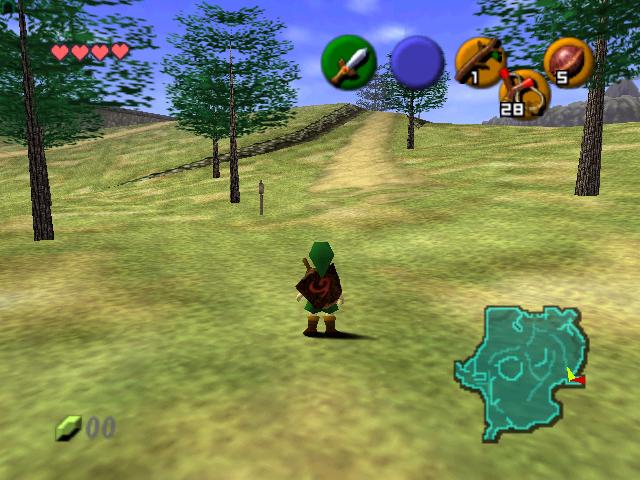
It was early Saturday morning. I had a good night's sleep since I went to sleep early the night before, and woke up just before the sun rose. I washed up, had breakfast and all, and then I was ready to do some work. But I didn't feel like I was in the working mood; I knew I was going to procrastinate. So I decided not to do any work; I put on my running shoes, got my iPhone and headphones, threw on my sweat top, and headed outside around 8:30AM. For some reason, the weather was very warm for the month of March in Vaughan (the city above Toronto, Canada), so taking a jog in a sweat top was perfectly comfortable. So there's a golf course behind my house, and since it's March, the season hasn't started yet, and therefore no one was using it. But since the weather was awesome, I decided to make use of it; I hopped over the fence, and started jogging through the fields while listening the the soundtrack from The Legend of Zelda: Ocarina of Time. I honestly felt like I was in the game! No joke! But without the green tunic, sword, and shield of course! The birds chirping in the real life environment augmented the musical ambiance, and they along with the squirrels - and of course the trees - added to the life of the visual scene. Additionally, the air was very moist and foggy, which was very soothing, and yet eerie at the same time - especially put together with an open field at dawn.

I felt like this guy.

Throughout my jog, I started to worry about larger animals in the area, like foxes and wolves. But I figured that many people use the golf course, and there's technically little forest for them to live in. Of course there's always a chance they may be around, but I figured hey, what good is life being cooped up in a room? Sure, there's risks involved with going outside, but sometimes taking risks is necessary to find inspiration in the life we have, and then be able to tell the tale - like what I'm doing now. Besides, it's unlikely that they'll appear; if it were likely for them to appear, then I'd call myself stupid for attempting something that could be considered suicidal. Furthermore, how do you think Link feels when he traverses the dangerous land of Hyrule? Sure, he has a sword, shield, other items to protect him, and he is a fictional character - but I feel that I should put myself in the character's shoes to understand his struggle, and then use my own similar adventure as inspiration to make my own works realistic enough for people to relate to.

Much like The Legend of Zelda, I decided to jog along the unpaved paths, and cut through the small forests. I also jogged beside a small river separating the cliffs and ledges above me, while often pausing to enjoy the scene. Eventually I made it through the golf course, and walked across a broken fence upon another subdivision. This subdivision was not too far from my house in terms of driving distance, but quite far in walking distance. I continued my open-ended and undefined jog through the subdivision, and walked to areas which I've seen so often as a child, yet never been to physically. Imagine a game where you can see something in the distance, but could never get to. For example, The Legend of Zelda: Ocarina of Time. In Princess Zelda's courtyard, there are two windows, one on the left, and one of the right. One of them displayed a hallway of Mario paintings as some sort of an easter-egg. When I was a kid, I tried figuring out how to access the hallways and explore Zelda's castle, but couldn't. Then, when I got older, I hacked into the game using a ROM and emulator, allowing me to jump into that inaccessible hallway. To my disappointment, nothing but a void surrounded that hallway; what I saw as a child was the only thing there. In fact, there wasn't even any collision physics, so Link couldn't even walk on it; he'd fall straight through the floor. It's also similar to my experience in Disney World when I was around six years old; there was little cartoon village with doors for each building. I was curious to see what was behind those doors, so I tried opening them. To my disappointment, they were sealed shut. I even had a dream about what could have been behind that door; when I opened it in my dream, there was an open void full of stars one would see in the night sky. I couldn't fathom what was behind the door, but I always had the feeling that it was full of something wonderful. Today, now that I'm older, I know that those doors were sealed shut because there wasn't anything behind them; they were fake. Talk about a disappointing truth. So going back to my adventure, I went to the areas I could never walk to as a child, because I knew that unlike a video game where "what you see is what there is", there does exist content in the "unexplored areas". I just wanted to complete my knowledge of their existence left incomplete from when I was a child.

DOOR
Y U NO REAL?

As I continued my adventure, I came across a house with a strange design on its door. It looked somewhat like a face. I recall many games that have strange designs, some of them that look like faces; but such designs are are often reused throughout their respectful games. For example, The Legend of Zelda: Ocarina of Time. There are towers where Link can shoot his Hookshot item at, in order to propel him across voids. The symbols on these towers look somewhat like faces, and I often found them throughout the game. I then related this to the concept of "echoes" from Alexander's Fifteen Properties of Living Structures, which makes use of "pleasing and unifying repetition". If this adventure of mine was a video game, and the house with the strange door was a place of significance, then the strange symbol would infer that. But that wouldn't be enough; there should be echoes of that symbol in the game, so that the player can be familiar with it before discovering the house with that design on its door. For example, the symbol should be displayed in different areas of the game as the player moves toward the strange house (for example, posters, tiles on the floor, etc.) except houses and their doors. Only one house will have the symbol on its door, and when the player makes the connection, s/he will realize that there is something mysterious about the house, and that will give them an incentive to explore it; no one will need to directly tell them that there exists a "strange house" in the area, because the environment itself already suggests that.

I saw those little faces even before I reached Dodongo's Cavern - the second dungeon.
You get the hookshot right before you reach the fourth dungeon.

Back to real life. There were some areas I wanted to get to though an unpaved path that I'd create on the spot, but sometimes those paths would go though one's backyard. I avoided this so as to avoid disturbing and/or scaring residents, so I decided to make paths that didn't run though someone's backyard. Although I could have taken the risk, the other options I had to get there were more appealing (for example, the longer path that goes around the house, which involves significantly less risk, but takes up a little but more time). Then there came another time where I found an area that contained a "The Void" (From Alexander's Fifteen Properties of Living Structures). I wanted to go to it, but the only way involved going through someone's patio  beside their house. So I hoped for the best, took a dash through, and made it to the void. I later realized that there was another way to get to "the void", but it was a much longer distance from the riskier path I took. This scenario strongly relates to game balancing:

The time it takes to cross the path + the possible risk of the path =  the non-appeal of the path

The closer the outcome is to zero, the more appealing the path will be. Now when you have multiple paths which equal the same value, then things start to get interesting for the player. As for my game in particular, if the player does take the risk, and then bumps into the owner of the house who s/he's trespassing, what would happen? Would the owner call the police, get angry, or become friends with the player? This would make the game even more interesting for the player. What if the risk could be rewarding? What if the risk could be punishing? These are the things I thought of as I adventured; what if this adventure was a game? What makes this adventure interesting? In a way, I attempted reverse-engineering the mechanics of real life as if it were a game. Imagine if real life were a video game. How would you play it? How would you "complete your game"?


For some people, this is their video game. And there's no extra lives.

As I continued my adventure through the subdivision, I discovered a hole in a meadow. I was a little worried of what it may contain, but I continued anyway. I shortly found my way out, and found a paved path before me. It curved to the left, and curved to the right; I had to pick whether to go left or right. The right side was an upward path with lit-up lights, and the left side was a downward path that looked nothing spectacular. Upon this first glance, the right side looked more interesting, and it gave me the impression that that was the path to take. However I wanted to see where both paths led to, so I decided to take a peek at the left side first. But after my first couple of steps toward the left, I realized that walking along the left path would probably take up a lot of time, especially since I had no idea how long that path would be. If the path is long, it would be tedious to walk all the way back to where I first made a decision of whether to move left or right, and then move along the original path I wanted to take. I then wished that I had a warp function in real life, so that I could see everything I wanted to see without sacrificing time. That's when I realized something; perhaps a warp function in this scenario would break my game. Because time is such an important factor, the player will be forced to make a conscious decision; either take the lit upward path, or the misty downward path. Depending on the player's choice, s/he will find whatever mysteries lie on the chosen path, while the other path will remain a mystery. Maybe the path not taken will be uncovered in the future as the player continues his/her adventure. I remember attending MIGS 2009, and a gentleman named Scott Rogers from THQ spoke about how he learned game design from Disneyland. One of the things he mentioned was multiple paths, and how even though they point to the same destination, the person would have a sense of choice. To me, that sounded like an illusion of choice, and although it may immerse the player into the environment more, I don't think it does nowhere near as good of a job as actual player choice. In my scenario, there was no illusion of choice; I had no idea where those paths were pointing to. They could have been pointing to the same destination, or perhaps not. Now consider the constraint of the player's time (which naturally resides in the player outside the game), and you've got yourself true player choice even in the most unconstrained and non-pressuring of scenarios. This is where I found myself.

I still have no idea as to how to respond to this picture... =S

So I ended up taking the path to the right, and discovered a tower with a few cannon replicas, which I've never seen before - even in despite of living in the area! It was created for the people of my town who lost their lives fighting in the first world war. I noticed a beer bottle on the window ledge of the tower, so I decided to climb up its base, and pick it up, while carefully jumping back down to the ground. I expected it to be a beer bottle from ten years ago (because seriously, who climbs things nowadays?), but in fact it was a soda from probably a few months ago. Meh, item attained I guess. But beyond the tower were steps trailing downward, with the Canadian flag and a few houses following in the distance. Perhaps those of the houses of members of the municipal government? I walked downward, figuring that this is where the left path in the previous scenario would lead to.

Eventually I found myself at an old community center where I used to play hockey as a child. I could have been a great hockey player if I actually participated in the game rather than divert my attention to getting a fly out of the ice. I digress...

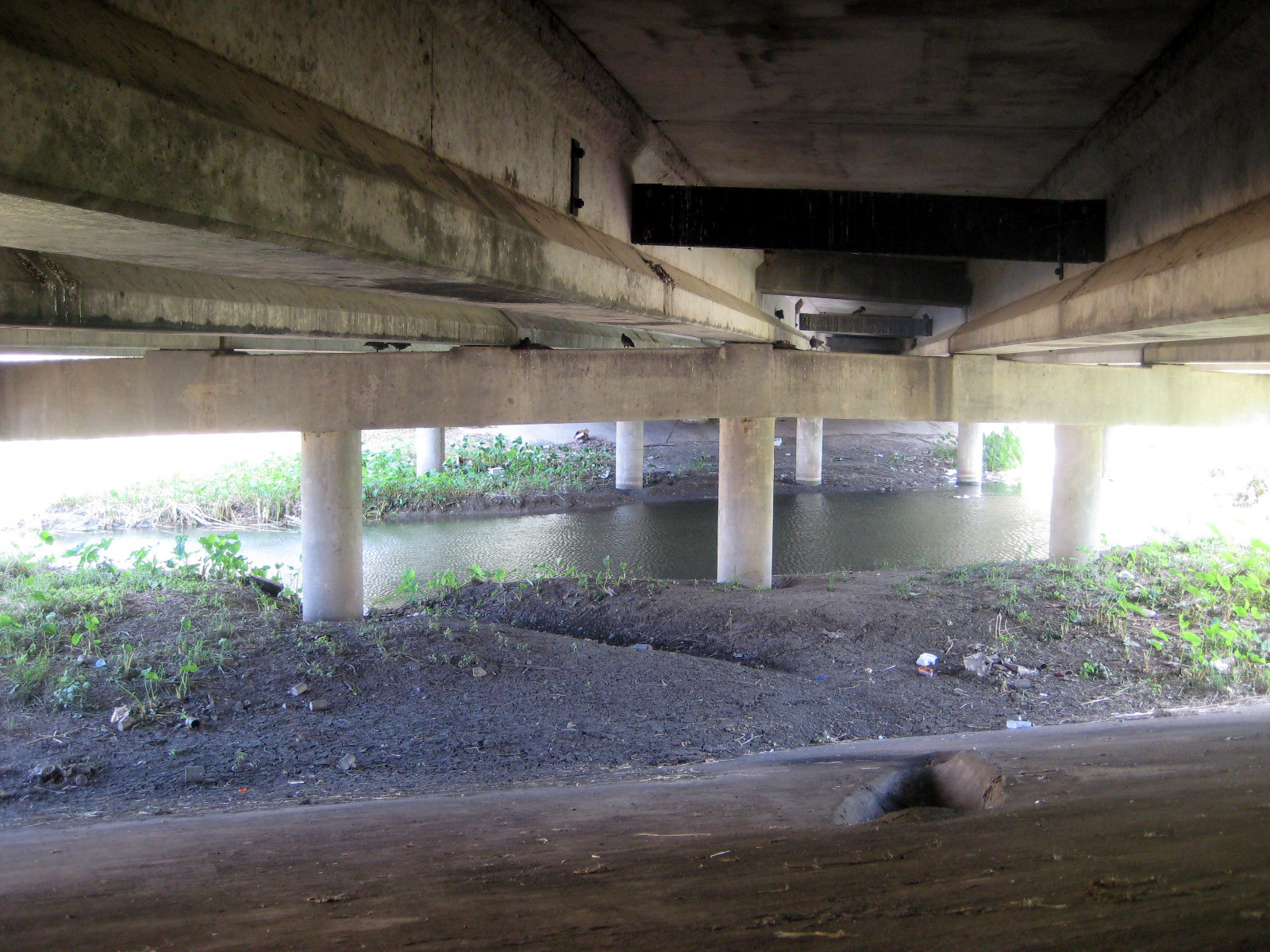
Across the community center, there is a road that runs over the river. My path on the other hand dipped below the road that bridges over the river, but just above the water of course. As I walked under the bridge, I felt like if I've been there before, perhaps when I was a small child. The memory is very vague, but I do feel like if I've been there before. It was definitely a strange feeling.

I... think I've been here before....
(This is not the actual picture, but it looks similar.)

Eventually, I made it to the community center, and then decided to go back home. I tried taking all the short cuts I could, and walked across the golf course again. I eventually had to jump over a fence, and all of the sudden, the Zelda music I was listening to suddenly stopped. Oh well, I guess a branch took out the headphones. Keep moving. Not too long after, I jumped over a fence into someone's backyard, I quickly rushed out, and made it onto the road of a new subdivision. That's when I realized that my phone was not in my pocket anymore. I started to worry. I went back to the fence I jumped over, and looked around for a while until I remembered when the music I was listening to cut off. Perhaps that was when the phone fell out of my pocket. I went to that area, and there it was in the leaves. I picked it back up, hopped over the fence, quickly dashed out of the stranger's backyard again. I had to teach karate that day, and realized that I was going to be late, so I called my mother to pick me up and drive me home. I wanted to finish my adventure on foot, but oh well. I was still late for karate anyway. Thankfully I'm not the only instructor at the dojo on Saturdays.

So to wrap up, I learned that the concept of "echoes" can be used to subtlety point out an object or area of importance, and how a player's real-life time outside the game s/he is playing can be used as a path choice constraint provided that the player does not have a warp function. I also learned that player's time added to a potential choice's perceived risk give rise to conscious player choice and ultimately interest. Furthermore, allowing the said 'risk' to possibly be good, bad, or anything in between, throws even more spice into the equation. Most importantly, I learned that pretending to traverse the lands of Hyrule while listening to Zelda music is an exhilarating trip, and is something I would do again. Rather than sit in-front of your computer and/or live within the confines of society, jump out and do something you've always wanted to do - even if it is completely ridiculousness. I assure you that it will bring you much joy, and offer tons of inspiration which you can use for your own creations and/or life philosophies.

Until my next blog post, thank you for reading, and arrivederci! =)

P.S. I found a fortune under the cap of the bottle I picked up. It said something along the lines of "contact those who are interested in your project". Interesting...

Monday, February 6, 2012

Magic the Gathering - My Made-up Cards

Hello everyone, this week I was given the task to create three new cards for the popular card game, Magic: The Gathering. Within that task, I was to balance the cards so that they can be playable in the actual game; costs = benefits. The rules for both costs and benefits are as follows:

Costs:
 Baseline = +1
 Each colourless mana = +1
 Each coloured mana = +2
 Total mana cost of 5 or more = +1 (+2 for Green)
Benefits:
 Each 1 Power or 1 Toughness = +1
 Being Red or Blue creature = +1


First up is the Isolated Boy.

His costs include:
1. The card baseline. (1)
2. Three colourless mana. (3*1=3)
3. One coloured mana. (1*2=2)
4. The cost so far is >= 5, but the card is not green, so there's only an added cost of one. (1)
5. Together, that equals 7.

His benefits include:
1. Power of 3.
2. Toughness of 4.
3. Not a Red or Blue creature. (0)
4. Together, that equals 7.

Isolated Boy's cost (7) equals its benefits (7), and is therefore balanced.


Next up is the Toddler's Drawing.

His costs include:
1. The card baseline. (1)
2. One colourless mana. (1*1=1)
3. One coloured mana. (1*2=2)
4. The cost so far is not >= 5, so there's no added cost. (0)
5. Together, that equals 4.

His benefits include:
1. Power of 2.
2. Toughness of 2.
3. Not a Red or Blue creature. (0)
4. Together, that equals 4.

Toddler's Drawing's cost (4) equals its benefits (4), and is therefore balanced.


Finally, we have Linkolian. No he is not Link from Nintendo's "The Legend of Zelda", he just looks strikingly similar to him. Sheer coincidence, honest! =P

His costs include:
1. The card baseline. (1)
2. Fifteen colourless mana. (15*1=15)
3. One coloured mana. (1*2=2)
4. The cost so far is >= 5, and the card is green, so there's an added cost of two. (2)
5. Together, that equals 20.

His benefits include:
1. Power of 10.
2. Toughness of 10.
3. It is not a Red or Blue creature. (0)
4. Together, that equals 20.

Linkolian's cost (20) equals its benefits (20), and is therefore balanced.

So that's that. Whadda ya guys think? Fancy? =]

Thursday, February 2, 2012

Pokemon Resources Short Critique


                Pokémon is a well-balanced game that uses many variables in a very intricately laid out fashion.  They work together to give a realistic feel for the Pokémon world; allowing each Pokémon to be unique, even if they’re of the same species. Looking back to a previous iteration of the series, Pokémon Fire Red version, there was a frustrating spike near the end of the game. After attaining the final badge which allows the player to challenge the Elite Four, their Pokémon are significantly stronger than the final gym leader. This usually causes the player to farm their Pokémon’s experience points in order to level them up. Since the amount of experience points required to level up increases relatively to a cubic exponential degree, it will (for example) take a while for the player to level up his Level 50 Charizard to Level 60. That’s the most important part I would change. Thankfully, I feel that Game Freak addressed that issue in future games, like in the recent Black and White versions.

                There is one other aspect I would like to change, albeit a small issue, and it hasn’t been addressed even to this day: Poké Ball prices. I feel that the decreasing triangle relationship works for the regular Poké Balls, however all of the special Poké Balls are priced the same at 1000 currency. For the regular Poké Balls, they cost 200, 600, and 1200 for Poké, Great, and Ultra respectively. (There is only one Master Ball per game which the player receives as a gift near the end of the game.) The special Poké Balls benefit the player only under certain circumstances. So why bother purchasing a special ball, when one can buy an Ultra Ball for just 200 extra? Ultra balls have a x2 catch rate for all scenarios, while special Poké balls have a x1 or x3 catch rate depending on if the player used it in the particular scenario that it’s supposed to be used for. As a long-time Pokémon gamer, I feel that such specific scenarios occur very infrequently. There are also many different special Poké Balls, and it would be costly to purchase one of each ball for scenarios that the player may not even encounter. To boot, other than the Master Ball, there’s never a guaranteed catch; so if the player uses her only ‘Fast Ball’ and doesn’t catch the Pokémon, the player will have to resort to her larger supply of trusty Ultra Balls. I believe prices of such special Poké Balls should be cheaper, maybe around the price of a Great Ball – then would I invest in them. I also believe that among the many different special Poké Balls, the prices should vary depending on the possible frequency of the special Poké Ball’s use. Other than that, I think Pokémon is awesome!


Monday, January 23, 2012

Rules vs. Mechanics

Hmm, I read something interesting: http://www.raphkoster.com/2011/12/13/rules-versus-mechanics/


One day,  Ian Schreiber  tweeted, "Game designers: in your everyday use of the terms, is there a difference between “rules” and “mechanics”? If so, what?" Raph Koster decided to answer that, but unfortunately his answer was too large enough for a tweet. He basically explained that every game is composed of smaller games, and each of those smaller games compliment each other in a fashion that supports the overall game. Each of those smaller games are basically mechanics. For example, one mechanic would be the jumping mechanic; it first considers all your previous progress (which consist of many small games), the act of jumping (which utilizes the rules of physics, especially the force against gravity), and the act of landing on an enemy to kill it (where the rule known as "player colliding with enemy and player's last position was above enemy" comes to fruition). These acts are dynamics carried out by the player through her choices, all thanks to the existence of the mechanics, and the rules that give the mechanics their existence. It's like a building; the rules allow mechanics to exist, and mechanics allow dynamics to exist.

At least that's how I understood it. To be honest, the article was quite confusing, but it gives you another designer's perspective on game design semantics. I feel knowing the difference between rules and mechanics is important, as it will help the designer break down and carefully construct her experience knowing the exact nature of her components. In this case scenario, the designer will choose rules that are not too loose and not too tight. With that, the rules will naturally generate mechanics that the player can use to partake in the game - mechanics are the part that are consciously on the player's mind, not the rules; the player knows that she can jump on an enemy to kill it, but does not think about "the rules of physics allowing force to drift the player upward", and, "collision with enemy provided that the player is above the enemy on the y-axis on the previous frame". Finally, how the player uses the mechanics become the the very essence of dynamics.

Wednesday, January 11, 2012

Alhambra board game critique

Good day, ladies and gentlemen.

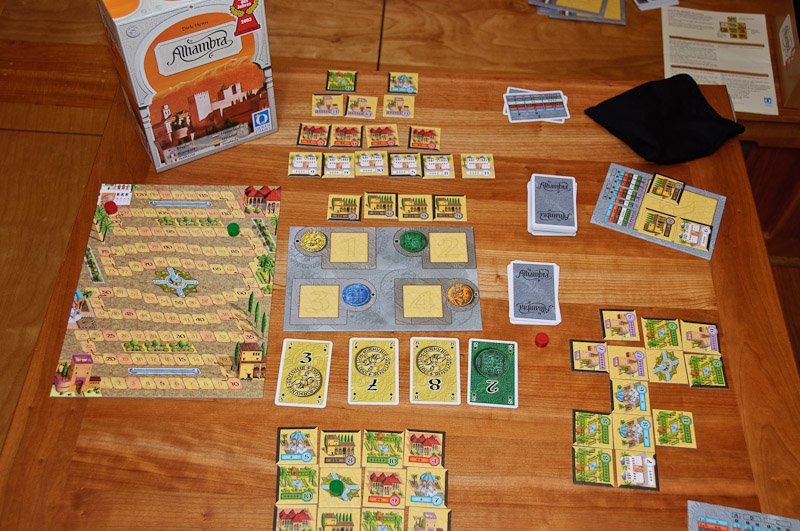
A few days ago, I played a board game called Alhambra (created by Dirk Henn) with four other people during Game Design II class. We took about fifty minutes to play it, as we were running out of time in the end. If we had the time to finish playing comfortably, we'd probably take an hour to play. The class and I were then asked to write an individual critique on the game we played. Now before I get into it, I might as well explain what the game is about, no?


Alhambra is turn-based in a clockwise order. For each turn the player has, she may choose to do one of the following; pick up money, use money on hand to buy buildings, or rearrange structures on hand. The money comes in four colours, and four are placed on the play table every turn. If the player picks up money less than a value of six, she may pick up another money card also worth less than six. The money gained can then be used to purchase buildings of the same colour. For any transaction, the player does not receive change. Each building card may have a black border around its edges; sometimes on one edge, sometimes on more than one edge, sometimes on all edges, and sometimes on no edges. The black boarders represent walls, which the player must carefully place together with other buildings to ultimately create a fortress. Inner walls are allowed, provided that the inner wall of one card is paired up with the inner wall of the adjacent building card. Regardless, inner walls provide no benefit to the player besides some leeway from having to match up walls perfectly on the outside. Sometimes buildings cannot fit in the current state of a fortress, so the player can put up to four buildings in her reserves area. When the player decides to take a turn to restructure her fortress, she can put any buildings she has in the reserves into the fortress (and vice-versa), and can rearrange her fortress however she sees fit. After the completion of one clockwise turn cycle, all players count how many points they currently have. Points are given by the amount of buildings each player has in their fortress; each building has a colour, and each colour has an associated value. So each player must add all values for each building they own, and then that total will serve as her current score. Once the game is complete, the player with the most points wins.


For the critique, the class and I were required to list five likable and five dislikable qualities of the game we played. I personally found it difficult to find ten distinct qualities I like/dislike, as points I fathomed seemed to overlap with other points. Nonetheless, I listed them the best I could:

Likable qualities:
1) The game is unique, especially thanks to its fortress mechanic.
2) There's strategy involved; for example, should I take the money or building this turn, or should I anticipate a better value next turn? Should I stock up on lower value buildings, or save up for high cost buildings that others might nab before me?
3) Inner walls allow leeway to constructing a fortress.
4) No change when buying something – contributes to strategy; if there’s money of value eight and money of value nine, pick up the money value of eight to buy building of value seven, then attempt to pick up the money of value nine the next turn.
5) Score card is like a board map, where the player’s pawn is on their score; allows player to know her score simply by glancing on the score card, rather than have someone to write it down.

Dislikable qualities:
1) The game felt repetitive and boring; it felt like busy work, a chore. I believe this is due to little challenge involved, while luck seems to mostly control the game.
2) I initially mistook the score card for the play field. I mostly found it to be useless other than taking up space.
3) Fortress doesn't seem to hold much purpose other than to include many buildings for points while requiring a wall to surround it. Player requires mostly luck to gain new parts. Not that challenging, just busy work. The game is more like a puzzle with extra tedious work if anything.
4) The same thing goes for money, luck is required to pick up the right money cards when they are displayed, and then luck is again needed to pick up the right building cards when they are displayed. It’s tedious.
5) The game is difficult to understand at first, which is a little frustrating. Once the game is understood, it's so easy to play and involves little challenge that is becomes boring.

If I could design a couple of elements differently, I'd say players should be able to bargain with other players in regards to buildings in reserves; if a player has a building in her reserves that another player needs, on his turn, he can either trade or buy her property – provided she accepts. This will increase accessibility of needed parts, which would shrink reliance on luck a little more, and thus allowing more room for strategy. Another design element I’d like to add is a more robust fortress system; each player has a pawn that can move around a game board every turn using dice, in addition to the original game. Each player’s fortress is constructed on the game board. Players can break into other players' fortresses. If a player gets to the fortress core of another player, she may decide to destroy it. She can also instead steal a building of another player’s fortress; if she does, she cannot steal anything else or destroy its core while she holds the building, so she might as well rush back to her own fortress without getting caught. Yes, in my version of the game, people can carry buildings, whadda ya know?

Anyhow, this is just what I think. How about you guys? DISCUSS FOO!!!!!!! C=<

Mr. T pities the fool who doesn't discuss in the comment section of this post.

Tuesday, January 10, 2012

ACT II

GOOD DAY LADIES AND GENTLEMEN

I HAS RETURNEDED!!!

IMPROPER USE OF GRAMMAR IS AWESOME!!!

Okay... I'm back.

Now I'm taking a course called Game Design II, which is the sequel to last year's Game Design I, where I murdered my ass off to make the world's crappiest game, Desert Racer!! Huzzah!!!! I won't be seeing you in my portfolio, sir!

No... no medal for you.

Thankfully this time, I'm continuing to develop PIVOTal with my group from last semester, and what a fine game it is so far!! This is way less stressful than last year, where I had to make a game from scratch unlike everyone else who had a game to build on from the semester before. Just thinking about that nightmare of a year makes me shudder... :(

Now THIS is what I'm talking about!! =D
Anyway, I just want to let you all know that anything that has to do with my GDW progress will now be found at http://protestersuoit.wordpress.com/. On this blog, however, I shall be posting material that is related to my Game Design II course.

Anyway, this is just a quick blog post to say that I am still alive, and see you all next post!! :)

Sunday, December 11, 2011

And we cut to intermission...

Hello y'all,

I finally completed all assignments for this semester. Now all that is left is to do exams. Since last week, I worked like crazy on my group's GDW game, marketing projects, and the Game Engine Homework. Thankfully the GDW was a great success, my marketing professors enjoyed my groups' presentations, and I nabbed all 65 exp. points for Game Engine Design. Before the GDW was due, I was working on a Particle Tool as per requirement for the GDW. Unfortunately I was not able to fully complete it, as it lacked RGBA adjustments. In case you don't know, RBGA stands for Red Green Blue Alpha. The first three colours when mixed create more or less the entire visual colour spectrum, depending on the value of each colour variable. Alpha represents opacity; the higher the value, the more opaque it is - the lower the value, the more transparent it is. After the GDW, I figured out how to integrate RGBA in my particle tool, and then submitted as part of my Game Engine Design homework mark. This brought my experience points from 35 to 50, giving me 100% of the homework marks.
This is my particle tool upon opening it. Simple grey texture with no effect applied. We can change that!
In this picture, I increased its red value, and decreased its green, blue, and alpha values. I also increased each particle's lifespan, speed, and size. Finally, I changed the direction of the emitter. Hmm... looks like a candle light!!
In my particle tool, I have three versions: point emitter (like the pictures above), planar emitter (like the one shown here), and air emitter (where all particles float around in the air). My particle tool has a feature where I can save a particle's attributes and load them whenever I want, even after I close the program. A few days ago, I set up my particles to look like mist in planar mode, and then saved its attributes. At the time of writing this post, I loaded up the text file by pressing a single button, and voila, my mist effect is back!!
However I was able to gain an extra 15 points, for a mark of 130%. I had two options, do three easy questions for an easy 15 points, or do one hard question and actually learn something that may be beneficial for studying for the exam. I chose the latter. The hard question I chose to do was a Normal Map Shader, that essentially makes a 3D model look more realistic. It proved quite difficult (hence why it's a "hard" question), and asked the professor for help. Unfortunately I was unable to complete it in time, however I did learn the theory of it quite well. Before I left with the 50 points, I approached the TA of the course, and showed him how I knew how to code the rest of the shader, but didn't have enough time. The TA then told me that although he cannot give me marks for it, I could do three easy questions quickly. I took the challenge, picked the easiest three questions, completed them in a matter of five minutes, and then the TA gave me my final marks. I quickly thanked him, darted out for the bus, and ultimately missed it. Oh well, I caught the next bus half an hour later, when I thought that it came every hour.
ARGH BUS, Y U NO WAIT?! :(
As for my final modeling assignment, I was forced to submit it incomplete. All I had to do was weight paint it (as in bind the model's skin to the skeleton I created), but it wasn't working the night before it was due. So I decided to go to sleep, and then ask the professor the next day (the due date) why I was experiencing my problem. I asked the prof what was wrong, he gave me information on how to work around it. The problem was that the model wouldn't go back to its bind pose (aka default pose) after I would move it. But he told me to ignore it, save the default pose as a separate file, and then export the skin weights to that extra file after I'm done weight painting. I also did another part of the assignment called "character sets", which I completed for the extra file, since I was to submit that. I ended up weight painting the whole body except for the neck and the fingers, as I was short on time. I then tried to export the weights, and that wasn't working, so I submitted the non-bind pose version. I then forgot that the character sets were on the extra file, not the file I was working on, so I submitted the extra file for the prof as proof that I have character sets. Hopefully he considers it!
This here's my level, which was part of my final modeling assignment. I created "character start" and "character end" locators in the scene, so that the GDW game program will know where the character starts and finishes the level. I also set up spotlights where the modeled lights are, in the scene.
Here's the final look of my model, Adolf Rothschild!! Although his weight painting isn't complete, and he has a small normal map error on his lip, he's come a long way. During the holidays, I plan to fix these small errors, and then I'll be able to fully animate him next semester.
Anyway, now all I have to do is study for exams, and after that, Christmas and New Years! Hooray!!
See you all next semester! =)

Sunday, December 4, 2011

Continuing crunch time... D'=

Hello everyone, everyone from game dev has recieved a week extension to our GDW project, as I expected. Once I heard the news, my productivity unfortunately dropped again. However it was restored when I realized that I have four assignments due over the weekend; Marketing Research group project, Consumer behaviour group project, Modeling level design, and finally the particle tool. Fortunately I finished my part for the Marketing Research group project, as well as for Consumer Behaviour. However I still have the other two to finish. My level is near completion, however I still need to do more work on the particle tool; which is the hardest part. Hopefully them all be done by Monday, which is the due date. Once all that is done, I'll have to present all three projects on Monday and Tuesday to the respective classes, complete my model's rig by Wednesday, and then nab my last 15 experience points for my game engine design homework by Friday. Currently I have 35 exp points, but my particle tool will constitute 15 points; so after that, I just need 15 points to get 130%. That's right, in actuality I need 50 points to get 100% on the homework, but my professor is giving us the chance to nab an extra 30%. What a nice guy!!... or an evil mastermind!!!!!!!!!.... yeah probably that. :)

Anyway, back to work! I shall make my final blog post for the semester after I'm done all my homework, and before I start studying for my exams. Wish me luck! :S

My level that I whipped up in a couple of hours.
I still have more work to do on it... and then I have to do the particle tool.... sigh.....
I hate procrastination so much, it causes me to endure so many sleepless nights,
yet I still continue to be its...... "you know what"....... :|

Saturday, November 26, 2011

CRUNCH TIME!!!

Hello ladies and gents! I was told last Monday that the GDW project was due in two weeks. I later found out that it was due THIS Monday. To make matters worse, I was behind in my work for my modeling course. "If you haven't created your model's skeleton, prepare to fail." Whew, at least I'm still alive... "Also, if you haven't painted your model's skin weights, prepare to fail". Oh no... Panic ensued Wednesday. Thankfully my bosses and my parents alleviated all my obligations for the weekend (after a plead of desperation, not a good way but anyway...) so that I can focus on helping my group make the GDW game. Since I was lost on how to do my modeling assignment 4, which consists of rigging my model (in other words, animating it to life), I decided to do my modeling assignment 5 (which is just painting its textures); then once I meet up with my modeling prof, I can get help from him in regards to assignment 4. Hopefully this will allow me to catch up.
This was my first shot at texturing my model for assignment 5. Creepy, eh? Don't worry, it looks much better now. :)
Anyway, now I'm with my group, since Thursday 2:00PM, working together on the GDW. Thursday night was late, Friday night was pretty much an all-nighter, and now here we are. We've collectively been working together, and Thursday was probably our most productive day. Some of my obligations (like save state and such) was accomplished by my group members, while I adopted the role of State Manager programmer from another group member of mine. It took me MUCH longer than I thought to code it, but I made sure that it was as error-free as possible, in order to prevent future headaches. Since coding the State Manager took all of Thursday and most of Friday, we suffered a bit of unproductivity on Friday, since most of the incomplete work could only be started after I finished the State Manager. But now that I finished the StateManager yesterday, I gave it to all my group members so they can wrap their work into my project. After teaching them how to use it, and help them wrap it from time to time, I started working on the shaders. I received a bloom shader from my game engine professor, but it was a stand alone program that was incomplete. So I wrapped it into my GDW program, and unfortunately runtime errors still arose. Since I was using the DirectX graphics engine to display the game's picture, I wondered if it were to work with OpenGL, another graphics engine. Although we were instructed to make the game in DirectX, putting the bloom shader into OpenGL worked! However, I still need to figure out a way to get it to work in DirectX. And create a particle tool. And figure out how to integrate animations, with the rest of my group. That's all on our plate currently... which is due Monday.... =S

FINALLY! A picture of team ProTester's GDW game: PIVOTal! In wonderful bloom visuals!!
Although my work is not very noticeable in the game at this current time,
it is still very essential, as it is the base of its code structure.
Anyway, that's about it for now. Hopefully we don't kill ourselves from sleep deprivation and eating unhealthy food. Thank you for reading, and until my next blog post, see ya! =)

Friday, November 18, 2011

Worries for the future...

Hello again!

After MIGS 2011 finished, I followed up with all people whose business cards I attained. Out of all the emails/tweets I've sent, Nels Anderson, Tom Salta, Dorian Kieken, Tristian Capacchione, Manveer Heir, Richard Lemarchand, and Jason Rohrer responded. Those people have now been elevated by a tenfold magnitude on my awesome people list.

Additionally I sent my game Happy Culture Shootout to Jason Rohrer and Nels Anderson after they showed interest in playing it. I was shocked, though I sent it to them with a disclaimer, explaining how it's not a racist game. I feel burdened that I created such a risky game, as many people received the wrong impression of it. Perhaps I should just pretend that I actually made no games in my past; maybe that will be better. Or perhaps I just need to make more socially-sound games to overshadow the misunderstood Happy Culture Shootout, well... once I find the free time to do so. Regardless, I hope their reaction to the game won't be negative, that's all I hope for.

Anyway, now that MIGS 2011 is in the positive memory bank, I've been back to working hard on school work (and taking the occasional Facebook/Twitter procrastination break, shame on me). On my list is an early exam for Marketing Research this Tuesday. Then I have two projects, one for that course, and one for my other marketing course, Consumer Behaviour. They are quite hefty research projects, but likely not as big as the GDW project. Then there's a group assignment for Project Management class due Tuesday (which I've done my part, but I may have to wrap up my other group members' work, who knows.), and then an unnamed final assignment for that same course. Then I had my Modeling Assignment 4's due date postponed to the last day of classes, where Assignment 5 and 6 of the same class are also due. I'm very behind in that course, so I've got to review the video lectures and catch-up; that may take a while. Finally I have homework for Game Engine Design, and must get to level 4 by the midterm. If I do that, I get 80% on the homework section of my final mark, so I must strive to attain a level 5. Heck, I'm able to get bonus marks by getting to level 6.5! But where is the time to do all of the above?! D=

NOW what about the GDW project? Well, much of its content is in regards to my Game Engine course so I might as well elaborate on that. So far I have made NO contribution to the GDW, unlike my group members. This is mostly due to my focus on other homework, MIGS, and procrastination. That's right, I never leave time to have real fun (like going out with friends, and/or playing video games) because I have "too much work", and then I end up procrastinating anyway. How ironic. Though I've realized that my life is actually near-perfect; the only thing standing in my way of it being perfect is myself. I am the last variable to unlock happiness mode, and so far I still haven't changed it. Hopefully soon I will.
I actually hate wasting time, i.e. procrastination; It keeps me from doing work,
which ultimately prevents me from having real fun, like playing video games
and hanging out with friends, like a normal human being should!
Anyway on my list for GDW is to make a Bloom shader, Bomb vertex shader (or enemy aura shader), scripting system (mainly to make animation controllers extensible), a versatile save/load class, AND a tool. I have to make a freaking tool, and I have only two weeks to do it, along with all the other work I have to do. Plus exams? This is going to be hell. Plus I hear one of my group members having trouble with making a Game State class. I suggested using the components method taught in class, but he said that it appeared to be difficult to integrate into code, and that we'd be better off just doing regular inheritence.

Oh man, the component method. Apparently rather than doing inheritance classes, there's a design pattern where the programmer makes a base GameObject class, and has an array of pointers to a base class called "component". Then component have have many derived classes, but only one iteration of derived classes. So now a game object can have the features of a car, plus the features of a boat, plus the features of a plane, etc. This is a lot more versatile and extensive than simple inheritance, having to make a car class, then a boat class, then a car-boat hybrid class; it becomes annoying. This is at least my understanding of it. I have so much more studying and refreshing to do. Oh the woes of a university student. Then I think, is it going to be any easier when I get an actual job in the game industry? If not, I really have to get my ass in gear and become an adult ASAP. Also when I mean become an adult, I mean to be more responsible, more independent, more confident, and more mature. It's scary to think though, because a few years back, I was just a kid in high school. It's like life is moving fast, too fast.

Anyway sorry that this post is quite short compared to my last three posts. It's because I made those posts way too friggen long. Now I'm reverting back to medium-length quick posts, so that I can focus more on doing work. See ya next week! :)

Tuesday, November 15, 2011

MIGS 2011 Day 2

I woke up early in the morning for MIGS Day 2, all psyched for Jason Rohrer’s presentation. Unfortunately I didn’t get much sleep the night before, as I went to the MIGS party, but left early as it felt boring to my friends and I. Unfortunately we walked out when Richard Lemarchand walked in, as he was the life of the party, giving out free copies of Uncharted 3, and doing crazy dances. Tis’ a shame that I missed it. Afterward I went to a bar with my buddies, and had a couple of drinks. Suddenly a drunken hobo approached our table and asked if we were trying to look like the band Linkin Park. I thought this man was balls off the wall. Then he leaned closer to me and said that my hair looks just like some band member’s hair, as he touched it with his grimy dark hands. I knew it immediately, “Yep, I’m taking shower once I get home”. So one of the guys and I left the table and ran back to the hotel (while the others stayed back to drink some more I guess), I took a shower at 4:00AM, and then woke up at around 7:30AM. 3.5 hours of sleep, yay!
If this guy was the hobo, he'd be my best friend. Otherwise please don't touch my hair, kthnxdude.
Anyhow, my lack of sleep didn’t steer me away from my excitement to see Jason Rohrer, the first game developer to invoke an intense emotional response from me after finishing his game, Passage; and to boot, it’s only a five minute game! Passage was developed as an “art game”, and art games focus on conveying a message through the medium of interactivity. Many people (myself included) consider Passage, among many of his other games, to be works of art. I believe this ideology marks the beginning of a new era for games, where interactivity is used to express a story/message/experience/art/etc, setting it apart from other artistic mediums like film, music, novels, visual art, etc. Unfortunately the game industry today is culturally known as some niche market, somewhat like the comic book industry. Today's cultural stereotype of game culture is composed of nerdy white adolescent/adult men who like to sever their relationship with society and hide in a dark room to play games.
THIS IS AN OVERUSED GOOGLE IMAGE!!!
Although Jason Rohrer is a pioneer in the design shift, he too changed his outlook on game design once again, noting that a game must contain the right amount and degree of challenge to keep the end-user captivated in the game world, and then will the game have the capability of invoking a more profound emotional response.
Jason started off mentioning Call of Duty: Modern Warfare 2's enormous success, but illustrated on his presentation slide how it pales in comparison to blockbuster hits like James Cameron's Avatar. Then he brought up other films of the distant past (like Gone with the Wind), compensating inflation and world population, and found that Call of Duty looks even worse. His point was not to bog down the celebration of the industy's rise, but to tell everyone "not to celebrate our conquest of the mainstream just yet".
Apparently 1 billion viewers watched this movie when 2 billion people existed.
He then brought up the different game design critics. One of the people he mentioned was movie critic Roger Ebert, a man who initially believed that games can never be a work of art. However, as time went on, his opinion changed to the belief that it may be possible for games to be art, but still believes no games today can prove that. On an ironic note, Jason mentioned that before Ebert was a movie critic, he was a game reviewer. However, the primary individual he spoke of was Tom Bissell, as Tom recently confirmed that he will no longer play video games. Rohrer added that he currently knows no one (other than himself and his friends in the game industry) who plays games. "Why is that?", he asks. He then mentioned what he apparently normally states in his presentations; there’s a "cultural line in the sand", and some mediums fall above or below the bar. Above the bar are critically acclaimed movies, books, visual art, and even The Beatles representing rock and roll. Below the bar are video games, and other mediums that haven’t been universally accepted as a social norm. He hopes for the game industry to cross this line, but how? Perhaps creating more art games will do; he brought up how his game Passage caused some people to rethink the capabilities of game design. However, he quickly added that many critics stated that Passage is boring, and that it’s difficult to please everyone. To boot, he expressed a new belief in that the "art games movement" is dead, if not, dying. He believes that the art game movement (including his work and the work of Tale of Tales) is going about it the wrong way, as such games are boring.
Tom Bissell is not amused at the recent progress of video games.
So he took a dive into what constitutes boredom. He said plot is a good way to keep people interested in passive media like film, however we need more than just plot and interactivity to keep people entertained in active media like games. That's where challenge comes in, and as long as it's done right, it can push artistic boundaries. Then he explained today's paradox in the game industry, where games "need to be more accessible and easier", and brought up a picture of a female senior playing Wii. When there's no challenge, the game's tasks become "busy work"; a chore, if you will. He compared this paradox with the avante-garde filmmakers who resisted plot. Now those filmmakers embrace plot, and are experimental and expressive with it. The same scenario goes for games and challenge; "We need to be inventing new challenges that complement what we're trying to express."

I did nawt resist plot! I did nawt... o hai Mark.
However, he notices that game developers seem to have a broken approach to challenge; either making it feel like task-oriented chores, and/or repetitive. One example he brought up was Kane & Lynch 2 on the hardest mode. He would play through the same path, same cinematics, die and respawn at the beginning, etc. He tortured himself through this process ten times before switching to medium. Then he brought up how Bioshock creates a false veil of engagement though its Vita-Chamber system; if the player dies during the game, she'll warp back to the vita-chamber without enemies respawning. Personally, I figure that the challenge there would be to finish the game without using too much time. So Rohrer experimented by using the weakest weapon in the game (the wrench) to get through the first level and defeat the first boss. It took a while, and lots of respawns, but he made it. Jason added that although he played Bioshock before and thoroughly enjoyed it. Not having played Bioshock myself (as I plan to purchase a PlayStation 3 when my wallet can do so), I'll take Jason's word that it sports a false veil of engagement, but I have a hunch that its engagement holds true because of the aesthetics and theme of the game coupled with smooth non-tedious gameplay; like a fresh new roller-coaster. There's little true challenge, but it's fun as hell, and they managed to pull it off.
Apparently this eliminates challenge, but it allows Bioshock to be a fun roller-coaster ride!

Afterward he went over games that handled challenge properly, like Far Cry 2, Demon's Souls, and most important (to me anyway), Minecraft. I must say that although I'm not an avid Minecraft player, I find its mechanics, and more particularly its dynamics, incredibly intriguing from a game design standpoint; and to wrap it all up, its aesthetics naturally compliment its system. Anyway, what these games share in common is the "freedom of approach" method, where players create their own path to accomplishing a certain goal.
You can make pretty much anything in Minecraft, thanks to its genius mechanics.

Another batch of games include Super Meat Boy, and Flywrench, which Rohrer deemed as "microchallenge games". Their challenges, albeit difficult, are broken up into tiny chunks, no lives limit, and respawn the player right before the challenge at hand. "That allows you to have this tight, rhythmic loop... as a result, you become so good at controlling these games". It gives the player a great sense of accomplishment. Now give it a sound jingle, and it all comes full circle.
The "World's Hardest Game" also fits into the microchallenge category. It's a very fun game, and that wouldn't be true if you had to start the game all over again when you lose all your lives. The Green spaces are checkpoints throughout the level. It gives the player a great sense of achievement when she reaches the checkpoints, and especially when she completes each level.

To be honest at this point, I've been looking at the Gamasutra article for reference of this blog post, however I noticed that it didn't cover everything. So I'll mention the rest that I remember.

The final batch of games he mentioned were ones I couldn't remember, but I think one of them was VVVVVV (a game I haven't played yet, yes I'm terrible). Anyway, he called them "renegade games", where their levels change every time the player starts the game up. It actually reminds me of a game made by a group of fellow classmates of mine called "When You Wish Upon A*" back in second-year; a racing game where the race track would be completely different every time the player restarts the game, thanks to the A* pathfinding algorithm. Very creative way of using a pathfinding algorithm, and their game kicked ass, unlike my crapsterpeice Desert Racer, which you can see in my earlier blog posts.
My second-year GDW project Desert Racer.
...
At least it's better than E.T. the video game!! :)
Finally he ended off on a somewhat pessimistic note. He went back to comic books, stating how their apparent challenge is to figure how to read it, especially if you're reading it to child; linearizing a somewhat nonlinear layout, if you will. This is what makes comics somewhat frustrating to get through, and is not as passive as watching a movie, or near-effortlessly reading the visibly-pleasing words of a novel. Perhaps this is what is keeping even the most critically-acclaimed active media below the cultural line in the sand, while keeping many passive works above. He said something like that I think, and that was it. I honestly felt that he ended off his presentation on some sort of cliffhanger, but remember that he too is currently in the pursuit of bringing the game industry above the cultural line. So I guess it would only make sense not to come to conclusions as of yet, as he has only given us his hypotheses of what may help us achieve our goal - hypotheses which root from his recent analysis of game design, and built upon his previous beliefs.
Speaking of cliffhangers, this is the last frame of Reboot.
I still hate you, Megabyte.
Oh yeah, and I lied; I also looked at this article for recap. Hopefully the video of Jason's presentation will be posted up on YouTube soon. If it also contains my embarrassing question at the end, I'll definitely post a comment on the video admitting that I was the dumbass who asked that question. What was the question? Well I deleted it off my phone, but it went something like "How do you find the most effective blend between art games and traditional games?" He responded with, "Did you not just listen to the entire presentation I just gave?" Then I oops-ed. I then asked him another question about his thoughts on the Legend of Zelda franchise (My favourite game series). From what I remember him telling me, he told me that it's a great series, and does what every typical major franchise does, more of it is made and released; as Nintendo is already releasing its 15th installment, Skyward Sword. He then said that if he did what Nintendo did and make Passage 2, he'd also be rolling in it. Personally I can't really visualize Passage 2. Hmm...
Snapshot of the action. I added the speech bubbles.
Photo credits go to Daniel Buckstein.
Following Jason's keynote was Alain Tascan's presentation. Alain basically went over how trends in the game industry are tending to move toward smartphone and tablet devices, and are slowly moving away from mainstream consoles. He then mentioned how his company "SAVA Transmedia" is working toward hiring more female workers. This really sparked my interest, since I feel that in order for this industry to progress, it must include people who don't normally play games to make games. This includes women in particular, because they can be found all over the world in all cultures and backgrounds, and ultimately hold different mindframes, perspectives, and thinking skills from men. In order to reach true success, both men and women must be on the team. So far we've got the male part, now we need females. So I asked Alian how to attract females to joining the industry like he has. Then a troll from the back shouted "Just look at him, he's a sexy man!", and the crowd chuckled. Then Alian explained that most of his female workers work in the arts and animations section, since all companies have to do is look at schools like Sheridan College, and pick up artists/animators from there. Since those types of schools are balanced male and female, it's easy to pick up female artists/animators to work on games, since their expertise is versatile; it can work for games, 3D animated movies, 2D animated movies, etc. However, the real challenge is to convince women to become games designers, as that's where the real crux of the game is created. I thanked him for his helpful information. It makes sense, we can't really expect women to jump on board the programming bandwagon as most females dislike math and programming (Though there are some girls who are totally skilled at it no doubt! But not many.), however they totally would suit being game designers, allowing their creative minds to have near-total freedom in the realm of interactive worlds... well as they long as the programmers are able to code their ideas. Constraints are always involved.
What if these girls made games? I know some of you guys may cringe at the thought,
but think, when have they ever been given the chance?
Afterward was Alex Parizeau's experience with managing "Monster Teams" on projects like Splinter Cell and Rainbow 6. I remember him mentioning setting tiers for project managers, all managing different aspects of each project, with a head manager on top; sort of like a basic project management grid. Then he went over that culture is very important, and zzz...
Yep, I dozed off. Was it because it was boring? HELL NO! It's because my lack of sleep from the night before caught up to me. I was so embarrassed and disappointed that I moved to the back of the audience, and continued dozing off there. I didn't even approach Alex for his business card at the end of his presentation out of sheer embarrassment on my part; and to boot, he's even from Ubisoft Toronto, which is probably the closest game studio there is to where I live. There goes my chance of getting my name known at Ubisoft Toronto. Plus, his presentation was very informative and interesting. Curse you sleep deprivation!!! Well at least I asked a classmate of mine if she could upload the notes she took of that presentation so that I could see them. One other thing I remember Alex mentioning as a strong point was "NOT to execute the plan until the design has been fully completed and agreed upon by all members of the project!".
I, among many students, lack sleep.
After Alex's presentation, I went to see David Anfossi's presentation on how he managed his team to create Deus Ex: Human Revolution. It's important to mention that this was Eidos Montreal's launch project! Making a high-scale game as their first game project was no easy feat, and David's postmortem exemplified that. It took his team four years to make the game, and in the beginning, the team only consisted of himself and a few other core members. He admitted it was his most challenging project. His team decided to make Deus Ex as a means to build an instant reputation for their team across the industry, and to attract talented game developers to join the project. It started from the team, he said. They know how they work best, they are the experts, so there's no need to force them to work in a specific pattern that may be detrimental to their production. Rather than delegate tasks to each member in a "do this, do that" fashion, they collectively worked on defining the theme and ambition of the game, which motivated team members. They didn't strive to make "an action RPG", their main goal was to "revive Deus Ex". The studio then played its previous installments in order to increase their familiarity with the essence of the series. They also used other works for inspiration, including Ghost in the Shell, and Bladerunner. With that, they analyzed what worked/what didn't, and set out to fix the percieved flaws that may have prevented the series from gaining a wider audience.
The Eidos Montreal team played the first two Deus Ex games, and watched sci-fi movies like Ghost in the Shell for inspiration. This was to ensure consistency with the theme of the series, and to build upon it.

Before the project was executed, David opened a forum to fans of Deus Ex for feedback, and many of them said things like, "Don't &%#@ it up!", and "Warren Spector's not on the team? No thanks!". With that, he chuckled that it was difficult to get constructive feedback from gamers. Although it's good to keep in touch with your consumer base, there's a particular time for it. He also stressed pre-produciton iteration, and that it's best to perfect them before integrating them on "the big machine". They also made three vertical slices to test the production pipelines before actual production. This was all done to ensure minimization of future error by the time production rolled out.
The protagonist of Deus Ex went through  many many iterations before his final look.
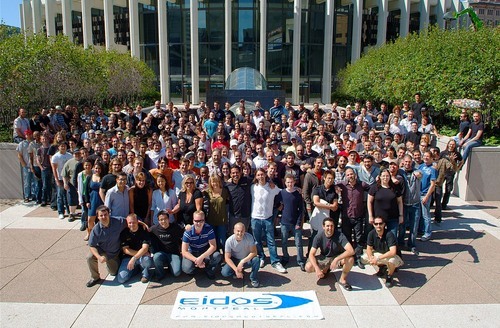
Eidos Montreal ensured this before project execution.
During production, David stressed that frequent meetings with team members were crucial, as it fostered stronger communication and ultimately ensured that the vision was consistent between members. When playtesting came around, he strongly advised his subordinates to "Listen to gamers. At the end, they are the final consumer." One of the most important parts of building a project is continuing to keep a positive relationship with the publisher. Picking a good team will generate results that gain a publisher's respect. However nothing is perfect, so the developer MUST be completely honest with the publisher. "No bullshit" he said. If the team cannot meet a deadline, the project manager must immediately let the publisher know, and "fight for the team" if needed. Finally he left with courage, team-spirit, and passion; as that will make the difference between an 85 and 90 rating. His team's game in the end achieved an 89. Wow!

Thank you Gamasutra again for the recap!
Congratulations, Eidos Montreal!!
Second last presentation was by Nels Anderson, who is pushing for 2D game popularity, especially among breakout designers. He mentioned mechanics, dynamics, and aesthetics, and how they all need to compliment each other. Mechanics are the hard-coded gameplay. Dynamics are the way the player uses the mechanics to express herself. Aesthetics are the game's visual and auditory theme. The game's mechanics invoke player dynamics, dynamics work within the aesthetics, and finally the aesthetics compliment the mechanics. He then went over how in a world of 3D games, 2D games made today have a different reception than they did back when 2D was the norm. Today, people don't know what to expect from 2D games, and now they can be used as a means to create new experiments - since the expectations of high-end graphics doesn't exist for 2D games anymore. 2D games are a wonderful medium for indie developers to start on. To add to Nels' information, I can easily see 2D games to fit in with the triple constraint (time, scope, cost), and will exude the game's design as the primary focal point - not its graphics or other high-end technology. I also remember Jason Rohrer mentioning that 3D is just a presentation choice, and doesn't constrain or enable particular game mechanics. "3D means you need to develop about 6x as much content (instead of one visible surface on a tile, a cube has six visible surfaces)". Thanks Jason, and thanks Nels!
Cave Story came out during the so-called HD-era of gaming.
Does Cave Story represent that? Not at all. Is it a damn good game? HELL YES!!
Finally, the last keynote was done by Ubisoft CEO Yves Guillemot, who expressed his thoughts on the future of gaming. But in short, his primary message was to expand the social aspect to online gaming; more people will be interactive in helping each other achieve goals in games. The feat can be taken outside the console, an on mobile phones in a sort of cloud gaming feat. For example, if the player needs a particular sword for a game, she can ask all her friends on her phone if they have one to spare. Once she finds a friend willing to do so, she can download the sword's data onto her account, and then use it on the console. He also mentioned how the online system could work for Wii U. I then asked him if that is the true online system for Wii U that Nintendo is showing it around to developers, or if this is just a Ubisoft design rooted from the current knowledge we have of Wii U. He confirmed it was the latter. My friend Albert Milaim then asked, "Why has Ubisoft chosen to implement such a feature, when internet databases exist to help the player?" In response, Yves explained that the player can choose to do that, but he's certain that most players will instead talk to friends (given the implemented system of future social gaming) to work together in solving a problem. Although online databases will exists, as long as Ubisoft promotes social gaming on next-generation online systems (like Wii U), people will likely use the service. At least that's what I understood. The most prominent thing that occured that I last remembered was some snotty nerd who stood up and told Yves that his online system is "suspiciously similar to Team Fortress 2" or something like that. Everyone at MIGS groaned at the awkward scenario, and Yves started scratching his head. To be honest, I don't remember what he said, but I think it was along the lines of "we're not setting out to copy anyone, we're just creating designs from our house that will help catapult the game industry to new heights in the online sector". Honestly that guy was an ass for embarrassing Yves like that. He could have stated his thoughts is a more polite manner, saying something like "your concept seems similar to Team Fortress 2, is that one of the inspirations for the new online system Ubisoft wants to push?" That would have been much more appropriate.  Unfortunately I guess some people don't know how to properly conduct themselves in a socially sound manner. I know I've been socially eccentric in the past, and I've been trying to overcome it. But I guess such a goal isn't apparent in some people. I'm sure he didn't think of himself as an ass, but as a hero, however his comment unfortunately caused other people to think otherwise. I was about to ask Yves another question, but time went up even though crowd focus was on me. I was just going to ask if there's a future possibility of seeing Ubisoft characters like Rayman on the next Super Smash Bros. Oh well.
And to end it off, a picture with Ubisoft CEO Yves Guillemot himself!!
Photo credits again goes to Daniel Buckstein. Thanks bud, you're awesome!
Anyway that was MIGS 2011! It was a blast, met so many amazing people, and learned so much. Now I have to focus on doing my part for my GDW group assignment for school, and I have about three weeks to accomplish that. Not to mention other school work I have to do too. Oh joy. Anyway, until my next post, see 'yall!! :)